
Reviewed · CITY TOURS
Private Evening Muscat City Tours
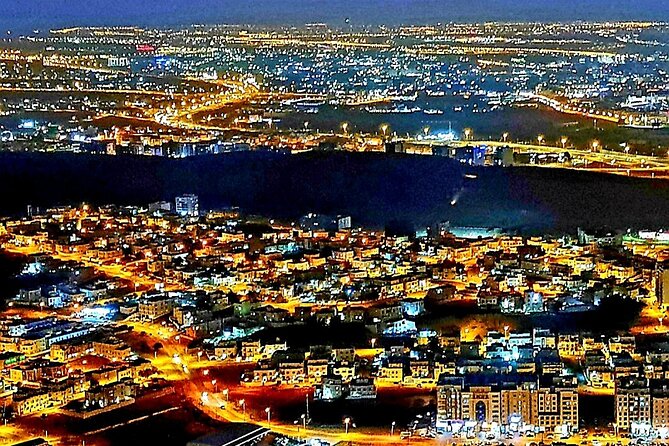
Catch Muscat in its evening light. This private four-hour outing gives you a useful first look at Oman’s capital, moving from mountain roads and grand mosques to the Muttrah Souq and Old Muscat waterfront. I like the easy private format and the chance to cover widely scattered sights without sorting out taxis. I also like the local dinner at the end. The main drawback is timing: several major sites are photo stops only, and some venues may be closed at night.
The route works best for a first evening in Muscat, especially if you want an overview rather than a long visit inside each monument. Guides such as Khalid and Khalil have earned praise for clear English, safe driving, and useful local explanations. Still, if the Sultan Qaboos Grand Mosque or Royal Opera House interiors are high on your list, plan a daytime visit separately.
In This Review
- Key points to know before booking
- Why an evening tour works well in Muscat
- Starting with Al Amarat and the mountain road
- Seeing Mohammed Al Ameen Mosque from outside
- Sultan Qaboos Grand Mosque and the limits of a night visit
- The Royal Opera House in Shati Al Qurm
- One hour in Muttrah Souq
- A sunset walk along the Muttrah Corniche
- Al Alam Palace in Old Muscat
- The harbor forts of Al Jalali and Al Mirani
- Dinner at a local restaurant
- What $106 per person gets you
- Who will get the most from this evening
- Booking details and weather planning
- Should you book the Private Evening Muscat City Tour?
- FAQ
- How long is the Private Evening Muscat City Tour?
- Is this a private tour?
- Does the tour include hotel pickup?
- Can I enter the mosques or Royal Opera House?
- Is dinner included?
- What is the cancellation policy?
Key points to know before booking
- Private touring keeps the evening flexible: Your group travels alone, with pickup offered and no strangers sharing the vehicle.
- The grand mosques are exterior stops: You get time for photos and explanations, but not a full interior visit.
- Muttrah Souq gets the longest stop: One hour gives you room to browse, shop, and reach the Corniche.
- Old Muscat brings the strongest setting: Al Alam Palace and the twin harbor forts sit among steep mountains and historic waterfront streets.
- Dinner is part of the evening: After the sightseeing, you eat at a local restaurant before returning to your hotel.
- Book ahead when your dates matter: This tour is often reserved about 22 days in advance, and free cancellation ends 24 hours before departure.
Why an evening tour works well in Muscat
Muscat is spread across several districts, with mountains pressing close to the Gulf of Oman. A short private tour can save you time because the sights are not arranged around one compact old center. You can see the main landmarks in one sweep, then decide which ones deserve a longer return visit.
The evening timing has real appeal. Muscat’s strong sunlight softens, the mountain edges become clearer, and Muttrah’s Corniche is at its prettiest as the day fades. The trade-off is access. The route is built around exterior views and photo stops, so you should think of it as an introduction to Muscat rather than a museum-style sightseeing tour.
The private format matters more than it might at first seem. You can ask your guide to explain an architectural detail, pause for a photograph, or spend more time shopping at the souq if the schedule allows. The exact level of flexibility depends on the evening and driving conditions, but a private group is a better fit than a large coach if you value a quieter pace.
More City Tours in Muscat
- Muscat: Budget Friendly City Tour
★ 4.8 · 321 reviews - Half-Day Private Muscat City Tour – Top Landmarks in Just 4 Hours
★ 5.0 · 256 reviews - Oman: Private Muscat City Tour With Pick-up/ Drop-off
★ 4.4 · 234 reviews
Starting with Al Amarat and the mountain road
The first stop takes you toward Al Amarat, also written Al ‘Āmrāt or Al Amirat, a city within Muscat Governorate. The area has its own local government offices, police station, municipality, and Wali office. You get about 30 minutes here, with no admission charge.
This opening section helps you understand Muscat’s geography. The city is not only palaces, mosques, and sea views. It also reaches inland toward the Al Hajar Mountains, and the road gives you a sense of how sharply the urban areas meet the rugged terrain.
Do not expect a major indoor attraction at this stop. Its value is visual and geographic. I would treat it as a useful orientation point, particularly if this is your first time in Oman and you want to see how the capital extends beyond the waterfront.
Seeing Mohammed Al Ameen Mosque from outside
Mohammed Al Ameen Mosque is a 20-minute photo stop. The mosque is clad in marble and sits off the Southern Expressway, at an elevation of about 62.5 meters above sea level. Construction began in 2008 and finished in 2014.
The building’s scale gives you plenty to photograph, even without entering. Its main prayer hall covers 1,616 square meters and can hold around 2,100 worshippers. The chandeliers are finished with 24-karat gold plating and Swarovski crystals, while the design and materials came from several countries, including Iran, Italy, Germany, Austria, India, the United Kingdom, and Italy.
That detail makes the stop more than a quick roadside glance. Your guide can put the building in context and point out features you might otherwise miss. Still, be clear about the limits: this is a photo stop only. If you want to see the prayer hall and chandeliers indoors, this evening tour will not provide that visit.
Sultan Qaboos Grand Mosque and the limits of a night visit
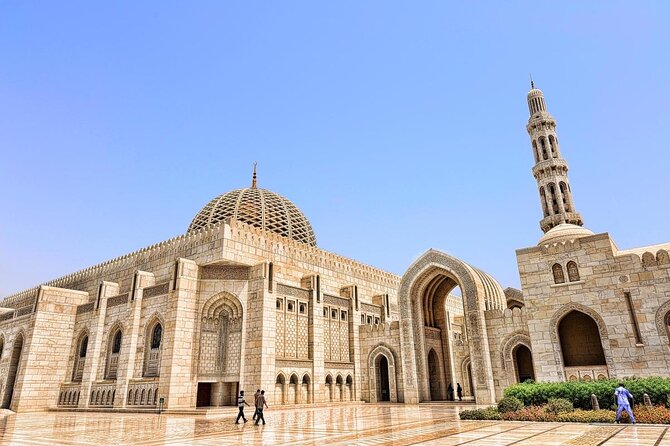
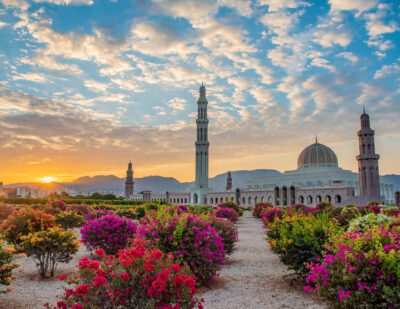
The Sultan Qaboos Grand Mosque receives about 30 minutes, also as a photo stop only. It dominates Muscat’s skyline with a central dome about 50 meters high and five minarets, a design linked to the five pillars of Islam. The main minaret reaches about 91.5 meters, while the other four rise to roughly 45 meters.
The main prayer hall holds more than 6,500 worshippers, and the women’s prayer hall accommodates 750. Outdoor paved areas and the interior courtyard add room for thousands more during prayer. These numbers help explain why the complex feels so imposing from the outside.
Night photography can be appealing, but the lack of interior access is important. One rating specifically praised the evening route while advising a daytime visit because some venues were not open. I would take that advice seriously. If the mosque is one of your main reasons for visiting Muscat, schedule a separate daytime stop and use this tour for the wider city picture.
A few more trips and experiences worth a look
- Muscat: Omani Dhow Coastal and Sunset Cruise
★ 4.6 · 198 reviews - Muscat: Evening Guided City Highlights Tour by Van
★ 4.8 · 175 reviews - Private Watching Sunset Desert Safari Tour
★ 5.0 · 71 reviews - Historical Muscat Sunset Tour
★ 4.5 · 60 reviews
The Royal Opera House in Shati Al Qurm
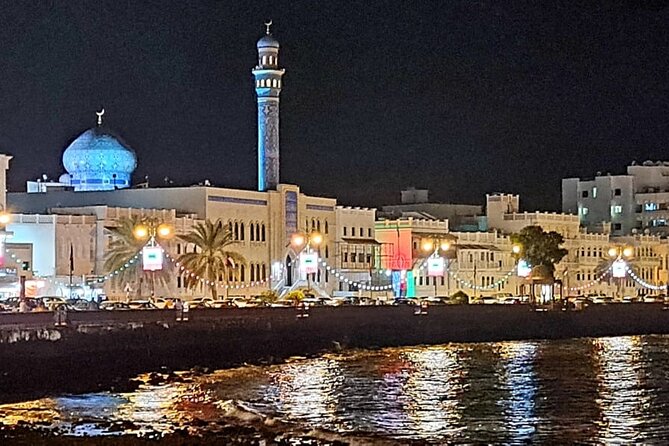
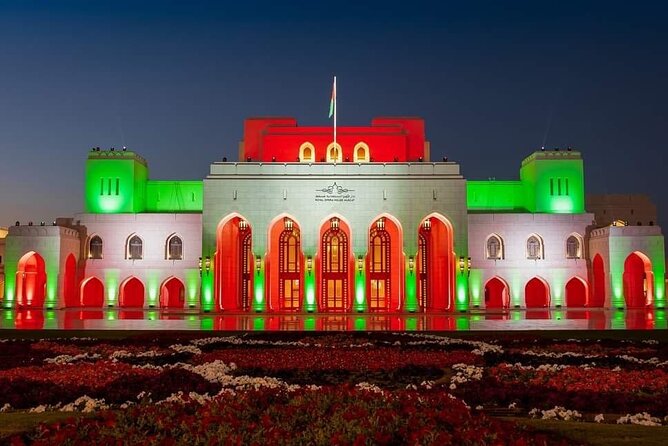
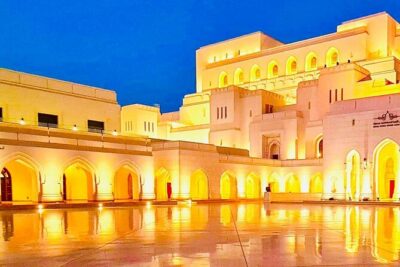
The Royal Opera House Muscat is a 15-minute photo stop on Sultan Qaboos Street in the Shati Al Qurm district. It is Oman’s leading venue for musical arts and culture, and its exterior gives the evening route a different mood after the imposing mosques.
This is a quick look, not a performance or interior tour. You may appreciate the clean architectural lines and the role the building plays in modern Omani culture, but do not book this experience expecting tickets or a behind-the-scenes visit.
The short stop works well in the wider schedule. It keeps the route moving toward Muttrah, where you have more time to walk and browse. If an opera performance matters to you, you will need another plan.
One hour in Muttrah Souq
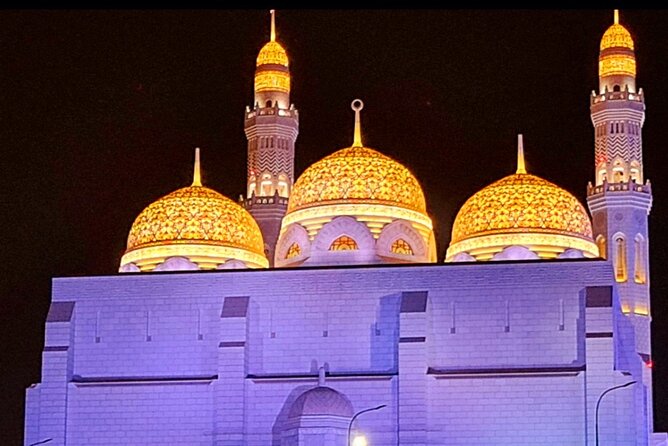
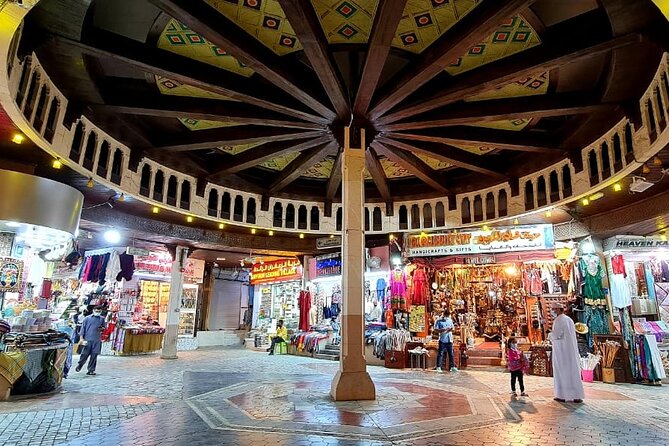
Muttrah Souq is the heart of this evening. You get about one hour, which is much more useful than the brief photo stops earlier in the route. The market is one of the oldest souks on the Arabian Peninsula, though the current building was rebuilt in the 1970s. A palm-frond roof was later added to give the passageways a more traditional look.
I like that this market still serves local shoppers rather than existing only for sightseeing. Shopkeepers may call out to you, but the atmosphere is described as less forceful than in the markets of more heavily visited destinations. That gives you a better chance to browse at your own speed.
Use the hour with a little purpose. Walk through the covered lanes, look at the displays, and leave time for the waterfront afterward. You might find local drinks and desserts along the way, since one guide included these small tastes during the evening. Do not count on a specific item being available, but it is worth asking Khalid or Khalil if there is time.
The market is also the best place to think about shopping. A private guide can help explain what you are seeing, though the tour details do not promise shopping assistance or fixed purchases. Keep your own budget in mind, and enjoy the simple pleasure of looking. In a souq, the atmosphere is part of the purchase.
A sunset walk along the Muttrah Corniche
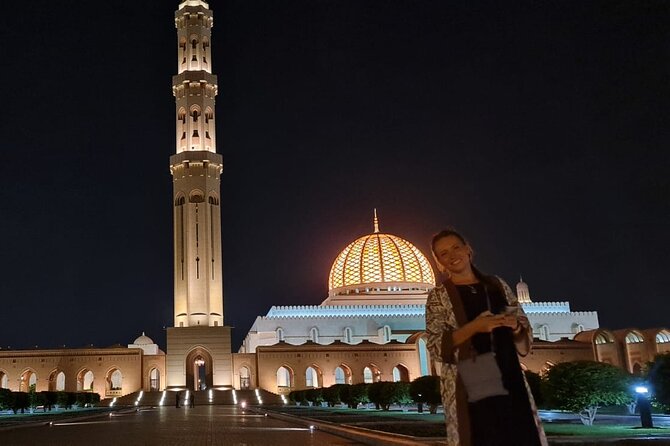
The Corniche runs alongside the souq, with latticed buildings, mosques, pavements, lights, and fountains. You get about 15 minutes here. That may sound brief, but it is enough for a short stroll and photographs if the group moves directly from the market.
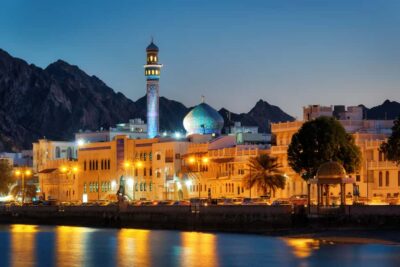
This is likely to be one of the evening’s most attractive moments. The Corniche curves beneath serrated mountains, and sunset can cast long shadows across the harbor. The setting shows why Muscat feels different from a dense modern capital. The city’s streets, water, and mountains remain closely linked.
The drawback is simple: 15 minutes is not a long walk. If you want to sit by the water, take a slow stroll, or explore beyond the immediate souq area, you may feel rushed. Tell your guide if the Corniche is a priority, and keep your shopping time under control.
Al Alam Palace in Old Muscat
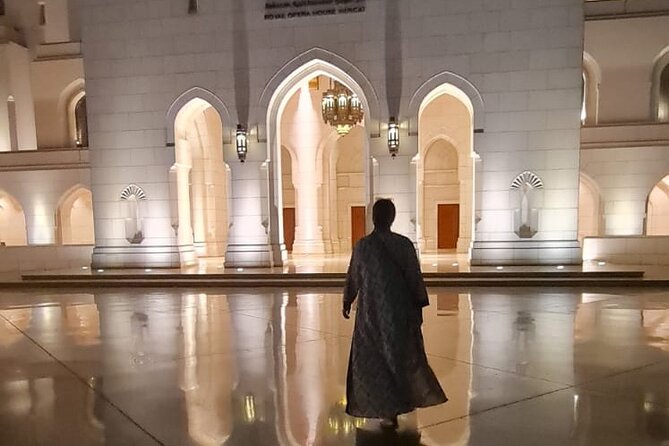
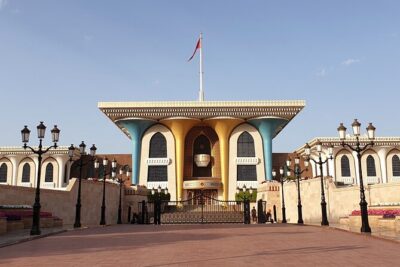
The route then moves into Old Muscat for a 30-minute stop at Al Alam Palace. Known as the Flag Palace, it was built in 1972 and serves as the ceremonial palace of Oman’s sultan. The palace is used to receive important visiting dignitaries, while the sultan’s daily residence is elsewhere.
The building is a good example of modern Islamic architecture, and its setting gives you a strong sense of Oman’s public image: formal, carefully maintained, and framed by mountains. You will view the palace from outside rather than enter it.
One unusual detail is the flag at the main entrance. If it is raised, the sultan is home. That is a small point, but it adds interest to what might otherwise be a quick palace photograph. Look for the relationship between the bright palace front, the surrounding buildings, and the steep slopes behind it.
The harbor forts of Al Jalali and Al Mirani
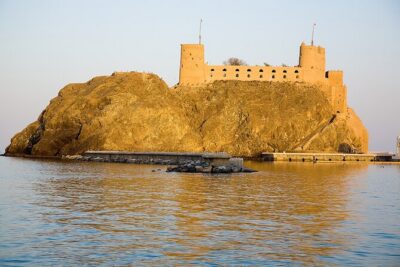
Al Jalali and Al Mirani guard the harbor of Old Muscat from opposite sides of the palace area. Both are photo stops only, with about 10 minutes listed for each location.
Al Jalali, also called Ash Sharqiyah Fort, was built by the Portuguese in the 1580s on an earlier Omani fortress. Its purpose was to protect the harbor after Muscat had been attacked twice by Ottoman forces. Omani forces took it in 1650.
Al Mirani also existed before the Portuguese invasion and was rebuilt by the Portuguese in 1587. It became the first fort in Oman to use cannons. These details give the harbor views a human story: control of Muscat meant control of a protected port, and the forts were built for defense, not decoration.
You will not tour the interiors on this evening outing. The short stops are enough for photographs and an explanation from your guide, but not for a close study of the fortifications. I would focus on the position of the forts, the water below, and the way they frame Old Muscat.
Dinner at a local restaurant
After the forts, the evening ends with dinner at a local restaurant before you return to your hotel. The tour information does not specify the restaurant, menu, or whether drinks are included, so you should confirm those details before booking if they matter to you.
Dinner is a useful finish because you do not have to find a restaurant after several hours on the road. It also gives you a chance to ask your guide about places and customs you have seen. One guide included local drinks and desserts during the evening, but those extras should not be treated as guaranteed parts of every departure.
The meal also affects how you judge the $106 price. You are paying for a private vehicle, pickup, a guide, city transport, and a meal component, not just for entry tickets. Since all listed admission stops are free, the value comes from saving time, getting explanations, and avoiding the work of arranging transport between distant districts.
What $106 per person gets you
At $106 per person, this is not the cheapest way to take a few photographs around Muscat. It becomes more reasonable when you are traveling as a small private group and want pickup, a dedicated guide, dinner, and a four-hour route in one package. Group discounts are offered, though the amount is not specified.
I would judge the price by your alternatives. If you are staying in Muscat for several days and have easy access to transport, you may prefer to visit some sights independently and spend more time at each one. If you have only one free evening, the private arrangement can be good value because it brings together Al Amarat, the mosques, the opera house, Muttrah, Old Muscat, and dinner without a great deal of planning.
The tour also appears to be popular enough that you should not leave booking until the last day. It is commonly reserved around 22 days ahead. Confirmation arrives when you book, and the activity is for your group alone.
Who will get the most from this evening
I would recommend this experience to a first-time visitor who wants a broad introduction to Muscat, especially someone staying in a hotel and looking for pickup and a return after dinner. It suits couples, families, and small groups who prefer their own vehicle to a large shared coach.
It is also a strong choice if you enjoy architecture, city views, and short historical explanations. The route gives you modern religious buildings, a cultural venue, a working souq, a ceremonial palace, and Portuguese-era forts in one evening.
I would hesitate if your main goal is entering the Grand Mosque, touring the Royal Opera House, or spending a long time inside the forts. The evening schedule does not provide that access. In that case, book a daytime visit separately, then use this tour only if you still want the private city overview and dinner.
Guides Khalid and Khalil receive especially strong praise for their English, local explanations, and driving. That matters on a short tour. A good guide can turn a sequence of exterior stops into a connected story about Oman’s faith, government, trade, and coastal defenses.
Booking details and weather planning
Pickup is offered, mobile tickets are available, and most people can take part. This is a private activity, so only your group participates.
Free cancellation is available until 24 hours before the local start time for a full refund. Within 24 hours, cancellations and changes are not accepted and the payment is not refunded. The experience also requires good weather. If poor weather causes cancellation, you can choose another date or receive a full refund.
Should you book the Private Evening Muscat City Tour?
Book it if you want a well-organized first look at Muscat, prefer private transport, and like the idea of ending with dinner. The best parts are the smooth city coverage, the one-hour stop at Muttrah Souq, the Corniche at sunset, and the chance to learn from a guide such as Khalid or Khalil.
Skip it if interior visits are essential to you or if you have enough time to explore Muscat slowly on your own. For everyone else, the tour offers a practical evening introduction to a city where the mountains, sea, markets, mosques, and forts are spread farther apart than they first appear.
FAQ
How long is the Private Evening Muscat City Tour?
The experience lasts approximately four hours, followed by dinner at a local restaurant and return to your hotel.
Is this a private tour?
Yes. Only your group participates in the activity.
Does the tour include hotel pickup?
Pickup is offered. The information provided does not specify the exact pickup area or time, so confirm those details when booking.
Can I enter the mosques or Royal Opera House?
No interior visit is specified for these stops. Mohammed Al Ameen Mosque, Sultan Qaboos Grand Mosque, and the Royal Opera House are listed as photo stops only.
Is dinner included?
The route ends with dinner at a local restaurant before returning to your hotel. The specific restaurant, menu, and drink inclusions are not provided.
What is the cancellation policy?
You can cancel at least 24 hours before the local start time for a full refund. Cancellations or changes made within 24 hours are not refunded or accepted. If poor weather cancels the experience, you will be offered another date or a full refund.
Just added around Muscat
- WADI SHAB – Muscat, Oman★ 5.0 · 3 reviews
- Private Transfer from Muscat to Wahiba Sand Desert by 4WD Vehicle★ 5.0 · 3 reviews
- Private Transfer from Muscat to Jebel Akhdar by 4WD Car★ 5.0 · 3 reviews
- Dimaniyat Islands Snorkeling Trip★ 5.0 · 3 reviews
- Dolphin Watching and Snorkeling Tour with Hotel Transfers★ 4.4 · 3 reviews
- Muscat trasfer: airport trasfer to/from hotel in muscat★ 5.0 · 3 reviews
- Tour Jawahir 2 Days-1 Night In Wahiba Sands, Oman Tours Package★ 5.0 · 3 reviews
- Airport to Hotel Private Transfer in Muscat★ 5.0 · 3 reviews
City Tours, compared.
Half-Day Private Muscat City Tour – Top Landmarks in Just 4 Hours
Read our review →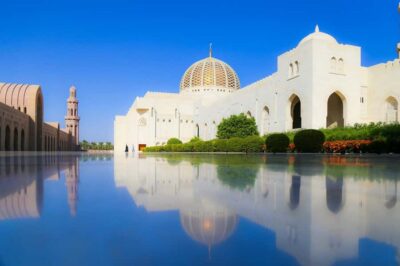
Private Muscat City Tour With Pick-up/ Drop-off
Read our review →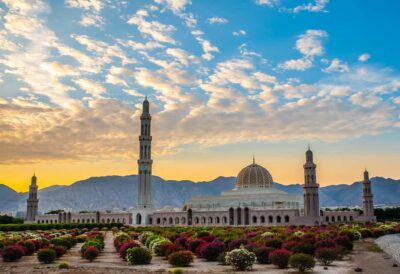
Half-Day Private Muscat City Tour- with a local guide
Read our review →
Browse the lists this tour appears in